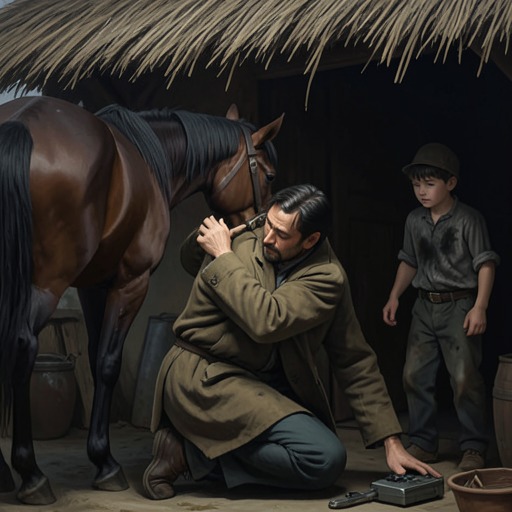
John Manly and James Howard as Mentor and Friend
Black BeautyJohn Manly and James Howard as Mentor and Friend is a relationship founded on practical instruction, earned trust, and mutual affection. John does more than train James for stable work: he stakes his own reputation on the young man’s character, helps him advance to a new position, and meets their separation with generosity rather than resentment.
Trust and Recommendation
When the master questions John about James, the inquiry concerns both his conduct and his reliability: whether he wastes time talking to acquaintances or leaves the horses unattended while out on errands. John rejects the suspicion and insists that he will not accept accusations without proof before witnesses. He describes James as steady, pleasant, honest, and smart, and says he trusts both his word and his work. In John’s judgment, James is gentle and clever with horses, and more trustworthy with them than many young men in livery. His emphatic defense makes his own name the guarantee of James’s character.
The master has been testing John’s opinion because a recommendation from him carries weight. He explains that Sir Clifford Williams wants a trustworthy young groom at Clifford Hall, someone who can learn alongside the aging coachman and eventually take his place. James is only nineteen the following May, but John considers him strong, well grown, and unusually careful. He points to his light, firm hand and quick eye, and especially to his attention to horses’ feet and shoes: John is confident that no horse under James’s care would be ruined through neglect of them. The recommendation rests on observed habits, not merely affection.
Training for Independence
John’s support becomes concrete preparation. Once James’s move to Clifford Hall is settled for a month or six weeks later, the master arranges as much driving practice as possible. James drives Black Beauty and Ginger on frequent journeys, while John initially rides beside him on the box to teach him. After that instruction, James drives alone. The change from supervised practice to independent driving makes visible what John’s confidence has helped secure: James is being equipped for responsibility, not simply praised for promise.
The practice includes demanding city journeys. On Saturdays, the horses are driven through unfamiliar streets and to the railway station as trains arrive. At the bridge, cabs, carriages, carts, and omnibuses crowd together; the narrow crossing and sharp turn toward the station require an alert driver and good horses. These journeys give James experience in precisely the kind of close, busy traffic where attention matters. The evidence presents John’s mentorship as patient preparation through real work, with the safety of the horses and other road users at stake.
The Example Behind the Mentorship
As James prepares to leave, John explains the experience that shaped his view of helping younger workers. When John was about Joseph’s age, his parents died of fever within ten days of each other, leaving him and his crippled sister, Nelly, without relatives able to support them. Their mistress found Nelly a room with Widow Mallet and supplied knitting and needlework when she could work; when she was ill, she sent meals and other comforts. The master, meanwhile, brought John into the stable under the old coachman Norman, giving him food, a bed in the loft, clothes, and three shillings a week so he could help his sister.
Norman could have refused to take on an inexperienced farm boy, but instead trained him with great care. When Norman died years later, John stepped into his position and eventually earned top wages, allowing him to save money while Nelly lived comfortably. John recounts this history as the reason he will not begrudge James’s opportunity. He has himself depended on kindness from an employer, a mistress, and an older tradesman; now he can pass that kindness onward by supporting a young worker even though the stable will miss him. His advice to James is rooted in remembered dependence and in the practical difference that patient instruction made to his own life.
Friendship and Parting
James answers John’s account by rejecting the idea that each person should look after himself alone. John makes the principle personal: without the help he and Nelly received, she might have ended up in the workhouse and he might have remained a farm laborer; without help from others, Black Beauty and Ginger might have died in the hotel stable fire. He sees care not as an optional kindness but as a responsibility made meaningful by the help people and animals have previously received.
Their affection becomes explicit as James prepares to go. He tells John that, except for his mother, John has been his best friend, and hopes John will not forget him. John promises that he will not, and asks James to remember him too if he can ever do him a good turn. Their exchange gives the professional relationship a reciprocal emotional shape: John has guided James, but James also names the friendship as one of the central bonds in his life. The parting does not cancel that bond. It marks the point at which John’s teaching has helped James move beyond the stable, carrying forward the trust and care that defined their time together.